

Context Package (RAG)
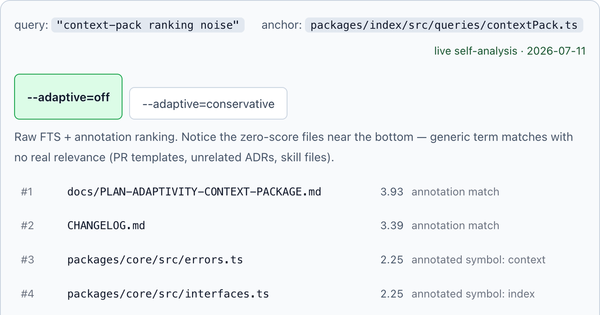
Same query returns better neighbors as your repo evolves, zero extra LLM calls.


Open source · $0 core · runs entirely on your machine
Doc↔code grounding, architecture visualization, hidden coupling detection. Evidence, not guesses.
Structural, behavioral and semantic rules, checked in CI, extracted straight from your ADRs.
Give your AI coding agent — Copilot, Claude, or any MCP client — real context about your architecture instead of letting it guess.
npm install -g @intentweave/cli && iw init
Zero LLM calls for indexing and enforcement. Add AI only when you choose to.
No sales deck. This is IntentWeave analyzing its own repository, live — click around.
Context Package (RAG)
Same query returns better neighbors as your repo evolves, zero extra LLM calls.
Doc ↔ Code Map
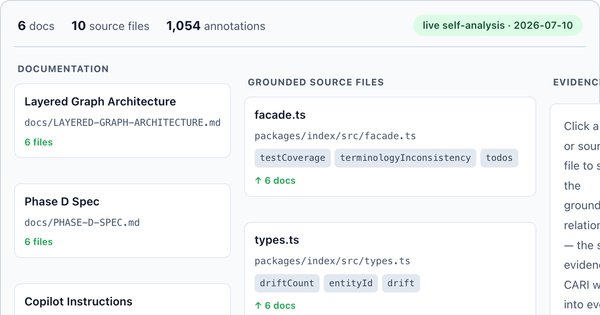
Every doc, grounded to real code. 1,054 annotations, zero LLM calls, computed in under a second.
Rules Catalog
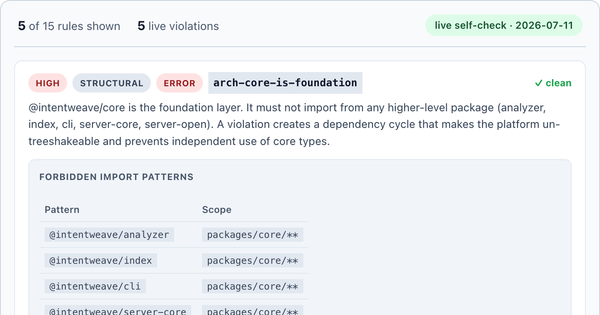
Structural and behavioral rules, checked against your real call graph — not just your imports.
npm install -g @intentweave/clicd your-projectiw initStep 1 — Observe (CARI Evidence Engine):
iw index build # < 3 seconds, zero API callsStep 2 — Enforce (Intent Engine):
iw intent check # check rules.yaml against the indexStep 3 — Deliver (Insights Book):
iw index export --book # open insights-book.htmlThe Insights Book shows your architecture, violations grouped by domain (structural / behavioral / documentary), per-ADR flow diagrams, call graph, and a living documentation score — all from a single local SQLite file. No LLM, no servers, no API keys required for steps 1–3.
iw index retrieve "authentication" # ranked file retrievaliw index connections "AuthService" # cross-layer connections + gapsiw index layers-infer # auto-infer architectural layersiw index clones # exact duplicate detectioniw index circular-imports # import cycle detectioniw index hotspot-priority # high-churn, low-doc files# Extract rules from an ADR once (requires LLM)iw intent extract docs/ADR-001.md --provider openai --output .iw/rules.yaml
# Enforce all three domains: structural + behavioral + documentaryiw intent checkiw intent check --domain behavioral # Mermaid sequence/flow rulesiw intent check --domain documentary # coverage + stale docs + terminology
# PR mode: only changed files, only high severityiw intent check --changed src/auth.ts --severity high --format json
# Regression gating: fail only if violations increasediw intent check --baseline .iw/baseline.json
# Living Documentationiw intent living # coverage, stale docs, terminologyiw intent score # composite A–F score (4 dimensions)CARI Evidence Engine — always $0
A zero-cost SQLite index built from your code’s AST, document keywords, and git history. No LLM. No servers. No API keys. 60+ query modes, architecture visualization, community detection, clone detection, call graph, and more — in under 3 seconds. The foundation. Always free. Always local.
Intent Engine
Three enforcement domains in one pass: structural (import graphs), behavioral (Mermaid sequence/flow rules), and documentary (coverage, staleness, terminology). All at $0 after a one-time LLM extraction step.
Semantic Enrichment (optional)
Selectively apply LLM extraction to the files CARI flags as highest-value. Budget-controlled, stored in the same SQLite index. Unlocks decision tracking, diagram validation, and cross-doc contradiction detection.
Knowledge Graph (optional)
Persist to Neo4j for full-scale semantic queries and impact analysis. CypherLite lets the same queries run against both SQLite and Neo4j — swap backends without changing code.
Architecture Visualization
Auto-infer architectural layers from your import graph. Generate an interactive HTML report with layered views, community clusters, dependency trees, vertical slice detection, and optional LLM-generated names — all in a single shareable file. No similar tool exists for this.
Ranked Retrieval
Find the right files for any topic. CARI combines code structure, document semantics, and git history into a single ranked score with explanations.
Connections & Gaps
See which entities co-occur in docs, co-change in git, or share code imports — and where these signals disagree. Disagreement reveals hidden couplings.
CI Drift Checks
Catch stale documentation before it ships. iw index check detects docs
that reference changed code and reports them as CI warnings.
Diagram Validation
LLM reads ASCII art and Mermaid diagrams in your docs, extracts component
flows, and CARI validates them against the actual import graph. The diagram
in your docs is the architecture spec — no YAML config needed.
Run iw index arch-check --from-scan docs/*.md --provider openai.
Decision Tracking
Selective LLM extraction finds decisions in your ADRs and docs. CARI checks
which decisions have code grounding and which are unimplemented or stale.
Available via the cari_enrich MCP tool, which scores files by impact
(hotspots, orphans, hubs, coverage gaps) for LLM enrichment candidacy.
Dead Feature Detection
Combine unused exports, undocumented symbols, and stale files to surface likely dead features. Three independent signals means fewer false positives.
Plugin Architecture
Install only what you need. Core ships zero-cost. Add LLM capability,
Neo4j persistence, or language support (Swift, Python) as plugins.
iw plugin add llm — done.
Measured on the IntentWeave monorepo (264 code files, 7 docs, 5316 symbols):
| Metric | Structured | Full-Depth | | ------------------------- | ----------: | ----------: | | Build time | 1.1 s | 2.8 s | | Annotations | 6,721 | 11,533 | | Grounded (linked to code) | 2,548 (38%) | 7,360 (64%) | | Co-occurrence edges | 1,099 | 2,631 | | LLM calls | 0 | 0 | | Index file size | ~2 MB | ~4 MB |
Full-depth mode adds +72% more annotations and +189% more grounded links by scanning document body text with dictionary matching and IDF-based noise filtering.
Source Code ──► AST Extraction ──► Symbol Registry (TS/JS/Swift/Python) │Markdown Docs ──► Keyword Extraction ──►│──► Annotation Engine ──► SQLite Index │ │ │Git History ──► Co-change Analysis ─────┘ IDF Filtering .iw/index.db │ ┌──────────────────┤ │ │ CLI Queries MCP Tools (retrieve, check, (cari_retrieve, connections, cari_connections, report) cari_check)No servers to run. The index is a single SQLite file. Queries are predefined SQL — sub-100ms latency. The entire pipeline is local and deterministic.
Vibe-coding AI agents and busy developers can easily implement against architectural decisions. IntentWeave turns your Architectural Decision Records (ADRs) and conventions into enforceable code constraints—without requiring Neo4j or LLMs in your CI.
Translate intent from plain-text markdown and check it in CI milliseconds later.
# LLM-assisted: Extract architectural constraints from an ADR into .iw/rules.yamliw intent extract docs/ADR-003.md --provider openai --output .iw/rules.yaml
# CI Validation: Check if the codebase violates any architectural rulesiw intent check --changed src/auth.ts --severity high --format text
iw intent extract options: --provider (e.g. openai), --output (specify rules file path).iw intent check options: --changed <files> (comma-separated, incremental CI mode), --severity <level> (filter by high/medium/low), --rule-id <id> (check specific rule), --format <format> (json/text). Runs as iw index rules-check under the hood — see the CLI Reference for every option.Let the diagram be the specification. Extract component flows directly from Mermaid or ASCII diagrams in your markdown files and validate them against actual code imports.
# Validate AST imports against flows found in diagramsiw index arch-check --from-scan docs/ARCHITECTURE.md --provider openai --strictarch-check options: --from-scan <paths> (extract on-the-fly), --from-diagrams (use previously enriched .db diagrams), --strict (fail on undocumented flows), --refresh (ignore cache).No LLM or config file required. These built-in rules run via fast AST analysis:
@deprecated signals.
iw index deprecated-callers --limit 50@internal and _ prefix visibility across package boundaries.
iw index internal-violations --changed src/ --no-underscoreas any casts in high-fan-in (highly depended upon) files.
iw index type-assertions --kind as_any --risk-sortiw index test-intent --format jsonThese rules run offline in milliseconds and plug straight into CI. Let standard tools review formatting, and let IntentWeave guard the architectural intent.
CARI automatically infers your project’s architectural layers from the import graph and generates an interactive HTML report — zero cost, zero configuration:
iw index layers-infer # infer layers from import topologyiw index layers-check # validate imports against layer boundariesiw index export --html # generate standalone architecture.htmlThe HTML report includes three interactive views:
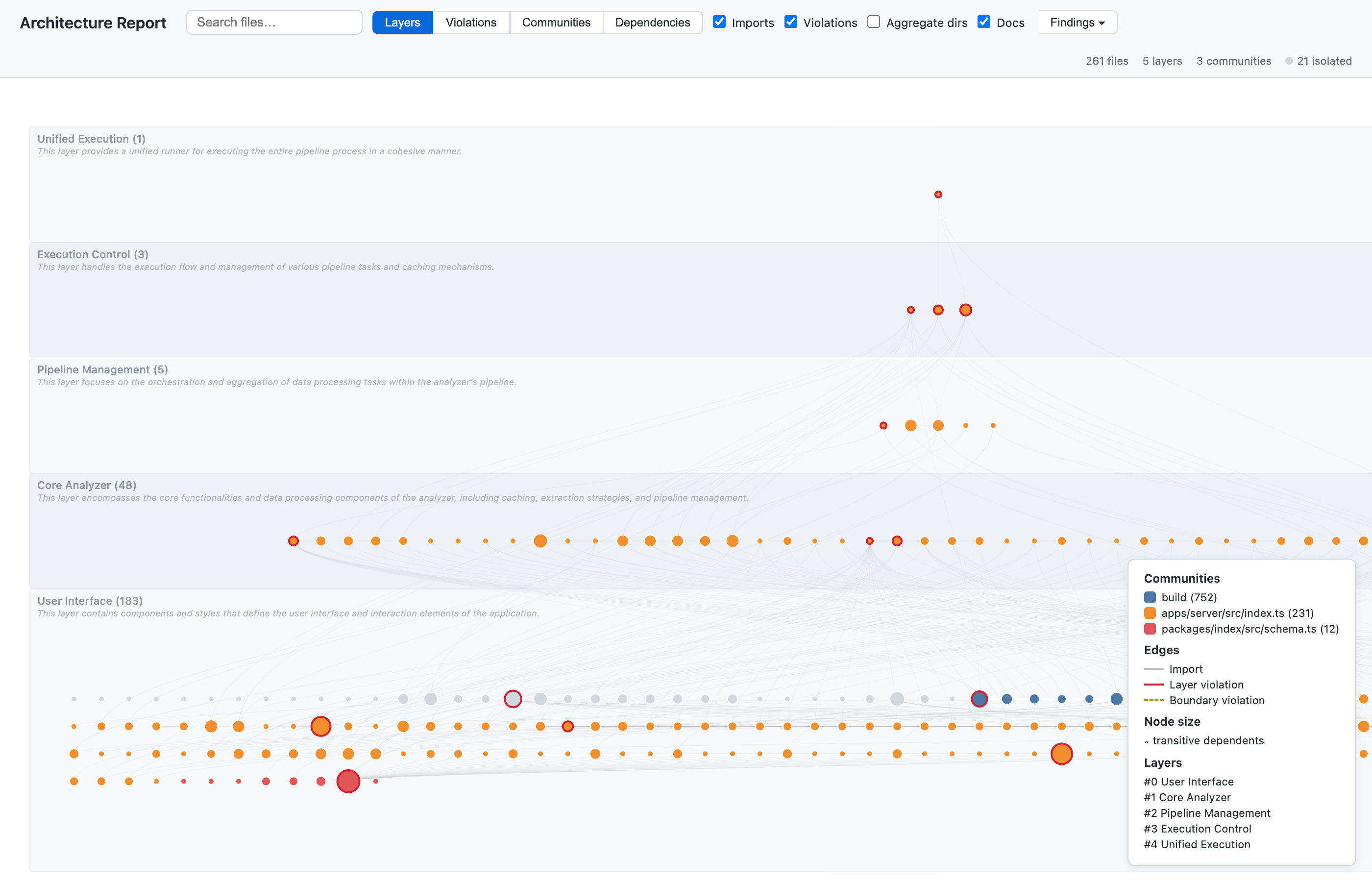
Features: directory aggregation, zoom/pan, edge filtering, node search, community mode switching, slice highlighting, and hover tooltips with per-file metrics (depth, dependents, risk, hub degree).
iw index export --html --provider openai --model gpt-4o-miniAn optional LLM pass names layers (“HTTP Layer”, “Core Types”) and directories (“CLI Subcommands”, “Pipeline Stages”) with one-sentence architectural descriptions. The report remains fully functional without this — heuristic labels are used by default.
IntentWeave grows with your needs. Start free, add capabilities when you need them:
$0, zero config + LLM (budget-controlled) + Neo4j (full scale)───────────────── ────────────────────── ────────────────────iw index build iw plugin add llm iw plugin add kg → 30+ code intelligence queries → decision tracking → full KG queries → architecture visualization → diagram validation → impact analysis → CI drift detection → contradiction detection → semantic search → clone detection → config-to-docs sync → cross-doc reasoning → community detection → same SQLite index → Neo4j persistenceNo lock-in — each layer is independently useful and stores results in formats you own (SQLite files, Neo4j database).
Contributing
See the contribution guide for how to get involved.
Roadmap
Check the roadmap for what’s next — 80+ features specced, 40+ already shipped.